Privacy Policy
Table of Contents
- Introduction and Overview
- Scope of Application
- Legal Basis
- Contact Details of the Controller
- Storage Period
- Rights under the General Data Protection Regulation
- Security of Data Processing
- Cookies
- Web Analytics Introduction
- Cookie Consent Management Platform Introduction
- Security & Anti-Spam
- Audio & Video Introduction
- Web Design Introduction
Introduction and overview
We have drafted this privacy policy (version 05.01.2026-313093158) to explain to you, in accordance with the provisions of the General Data Protection Regulation (EU) 2016/679 and applicable national laws. In short, we provide you with comprehensive information about the data we process about you.
In short: we provide you with comprehensive information about the data we process about you.
Privacy policies usually sound very technical and use legal terminology. This privacy policy, on the other hand, is intended to describe the most important things as simply and transparently as possible. Where it is conducive to transparency, technical terms are explained in a reader-friendly manner, links to further information are provided, and graphics are used. We therefore use clear and simple language to inform you that we only process personal data in the course of our business activities if there is a corresponding legal basis for doing so. This is certainly not possible if you provide explanations that are as concise, unclear, and legalistic as possible, as is often the standard on the Internet when it comes to data protection. I hope you find the following explanations interesting and informative, and perhaps you will find some useful information.
Scope of application
This privacy policy applies to all personal data processed by us within the company and to all personal data processed by companies commissioned by us (processors). By personal data, we mean information within the meaning of Art. 4 No. 1 GDPR, such as a person’s name, email address, and postal address. The processing of personal data ensures that we can offer and bill our services and products, whether online or offline. The scope of this privacy policy covers:
all online presences (websites, online shops) that we operate
social media sites and email communication
mobile apps for smartphones and other devices
In short: the privacy policy applies to all areas in which personal data is processed in a structured manner within the company via the channels mentioned. If we enter into legal relationships with you outside of these channels, we will inform you separately if necessary.
legal bases
In the following privacy policy, we provide you with transparent information about the legal principles and regulations, i.e., the legal basis of the General Data Protection Regulation, which enable us to process personal data.
With regard to EU law, we refer to REGULATION (EU) 2016/679 OF THE EUROPEAN PARLIAMENT AND OF THE COUNCIL of April 27, 2016. You can, of course, read this EU General Data Protection Regulation online at EUR-Lex, the gateway to EU law, at https://eur-lex.europa.eu/legal-content/DE/ALL/?uri=celex%3A32016R0679.
We only process your data if at least one of the following conditions applies:
Consent (Article 6(1)(a) GDPR): You have given us your consent to process data for a specific purpose. An example would be the storage of your data entered in a contact form.
Contract (Article 6(1)(b) GDPR): We process your data in order to fulfill a contract or pre-contractual obligations with you. For example, if we conclude a purchase contract with you, we need personal information in advance.
Legal obligation (Article 6(1)(c) GDPR): We process your data if we are subject to a legal obligation. For example, we are legally obliged to retain invoices for accounting purposes. These usually contain personal data.
Legitimate interests (Article 6(1)(f) GDPR): In the case of legitimate interests that do not restrict your fundamental rights, we reserve the right to process personal data. For example, we need to process certain data in order to operate our website securely and economically. This processing is therefore a legitimate interest.
Other conditions, such as the performance of tasks carried out in the public interest and the exercise of official authority, as well as the protection of vital interests, do not generally apply to us. If such a legal basis should nevertheless be relevant, it will be indicated at the appropriate place.
In addition to the EU regulation, national laws also apply:
In Austria, this is the Federal Act on the Protection of Individuals with regard to the Processing of Personal Data (Data Protection Act), or DSG for short.
In Germany, the Federal Data Protection Act, or BDSG for short, applies.
If other regional or national laws apply, we will inform you about them in the following sections.
Contact details of the responsible person
If you have any questions about data protection or the processing of personal data, you will find the contact details of the controller in accordance with Article 4(7) of the EU General Data Protection Regulation (GDPR) below:
bt2work GmbH
Galgenbergstr. 11
93413 Cham
Authorized representative: Christoph Erhard
Email: info@bt2work.de
Phone: +49 9971 310965
Legal notice: bt2work.de/
Storage period
It is our general policy to store personal data only for as long as is absolutely necessary for the provision of our services and products. This means that we delete personal data as soon as the reason for data processing no longer exists. In some cases, we are legally obliged to store certain data even after the original purpose has ceased to exist, for example for accounting purposes.
If you wish to have your data deleted or revoke your consent to data processing, the data will be deleted as soon as possible and insofar as there is no obligation to store it.
We will inform you about the specific duration of the respective data processing below, provided we have further information on this.
Rights under the General Data Protection Regulation
In accordance with Articles 13 and 14 of the GDPR, we hereby inform you of the following rights to which you are entitled in order to ensure fair and transparent data processing:
According to Article 15 of the GDPR, you have the right to obtain information about whether we process your data. If this is the case, you have the right to receive a copy of the data and to obtain the following information:
the purpose for which we are processing the data;
the categories, i.e. the types of data being processed;
who receives this data and, if the data is transferred to third countries, how security can be guaranteed;
how long the data will be stored;
the existence of the right to rectification, erasure, or restriction of processing and the right to object to processing;
that you can lodge a complaint with a supervisory authority (links to these authorities can be found below);
the origin of the data if we did not collect it from you;
whether profiling is carried out, i.e., whether data is automatically evaluated to create a personal profile of you.
According to Article 16 of the GDPR, you have the right to rectification of the data, which means that we must correct the data if you find any errors.
According to Article 17 of the GDPR, you have the right to erasure (“right to be forgotten”), which specifically means that you may request the erasure of your data.
According to Article 18 GDPR, you have the right to restrict processing, which means that we may only store the data but not use it further.
According to Article 20 GDPR, you have the right to data portability, which means that we will provide you with your data in a common format upon request.
According to Article 21 GDPR, you have a right to object, which, once enforced, will result in a change in processing.
If the processing of your data is based on Article 6(1)(e) (public interest, exercise of official authority) or Article 6(1)(f) (legitimate interest), you may object to the processing. We will then check as soon as possible whether we can legally comply with this objection.
If data is used for direct marketing, you can object to this type of data processing at any time. We will then no longer be allowed to use your data for direct marketing.
If data is used for profiling, you can object to this type of data processing at any time. We will then no longer be allowed to use your data for profiling.
According to Article 22 of the GDPR, you may have the right not to be subject to a decision based solely on automated processing (e.g., profiling).
According to Article 77 of the GDPR, you have the right to lodge a complaint. This means that you can complain to the data protection authority at any time if you believe that the processing of personal data violates the GDPR.
In short: you have rights – don’t hesitate to contact the responsible body listed above!
If you believe that the processing of your data violates data protection law or that your data protection rights have been violated in any other way, you can lodge a complaint with the supervisory authority. For Austria, this is the data protection authority, whose website can be found at https://www.dsb.gv.at/. In Germany, there is a data protection officer for each federal state. For more information, please contact the Federal Commissioner for Data Protection and Freedom of Information (BfDI). The following local data protection authority is responsible for our company:
Bavarian Data Protection Authority
State Commissioner for Data Protection: Prof. Dr. Thomas Petri
Address: Wagmüllerstr. 18, 80538 München
Phone number: 089/21 26 72-0
Email address: poststelle@datenschutz-bayern.de
Website:
https://www.datenschutz-bayern.de/
Data processing security
We have implemented both technical and organizational measures to protect personal data. Where possible, we encrypt or pseudonymize personal data. In doing so, we make it as difficult as possible for third parties to derive personal information from our data.
Article 25 of the GDPR refers to this as “data protection by design and by default,” meaning that security must always be considered and appropriate measures taken for both software (e.g., forms) and hardware (e.g., access to the server room). In the following, we will discuss specific measures where necessary.
TLS encryption with https
TLS, encryption, and https sound very technical, and they are. We use HTTPS (Hypertext Transfer Protocol Secure) to transmit data securely over the Internet.
This means that the entire transmission of all data from your browser to our web server is secure—no one can “eavesdrop.”
This means that we have introduced an additional layer of security and comply with data protection through technology design (Article 25(1) GDPR). By using TLS (Transport Layer Security), an encryption protocol for secure data transmission on the internet, we can ensure the protection of confidential data.
You can recognize the use of this data transmission security by the small lock symbol in the upper left corner of the browser, to the left of the Internet address (e.g., examplepage.com), and the use of the https scheme (instead of http) as part of our Internet address.
If you would like to know more about encryption, we recommend searching Google for “Hypertext Transfer Protocol Secure wiki” to find useful links to further information.
Cookies
| Cookies Summary
👥 Affected persons: Visitors to the website 🤝 Purpose: Depends on the respective cookie. More details can be found below or from the manufacturer of the software that sets the cookie. 📓 Processed data: Depends on the respective cookie used. More details can be found below or from the manufacturer of the software that sets the cookie. 📅 Storage period: depends on the respective cookie, can vary from hours to years ⚖️ Legal basis: Art. 6 (1) (a) GDPR (consent), Art. 6 (1) (f) GDPR (legitimate interests) |
What are cookies?
Our website uses HTTP cookies to store user-specific data.
Below, we explain what cookies are and why they are used so that you can better understand the following privacy policy.
Whenever you surf the Internet, you use a browser. Well-known browsers include Chrome, Safari, Firefox, Internet Explorer, and Microsoft Edge. Most websites store small text files in your browser. These files are called cookies.
One thing cannot be denied: cookies are really useful little helpers. Almost all websites use cookies. More specifically, they are HTTP cookies, as there are also other cookies for other areas of application. HTTP cookies are small files that are stored on your computer by our website. These cookie files are automatically stored in the cookie folder, which is essentially the “brain” of your browser. A cookie consists of a name and a value. When defining a cookie, one or more attributes must also be specified.
Cookies store certain user data about you, such as language or personal page settings. When you visit our site again, your browser transmits the “user-related” information back to our site. Thanks to cookies, our website knows who you are and offers you the settings you are used to. In some browsers, each cookie has its own file, while in others, such as Firefox, all cookies are stored in a single file.
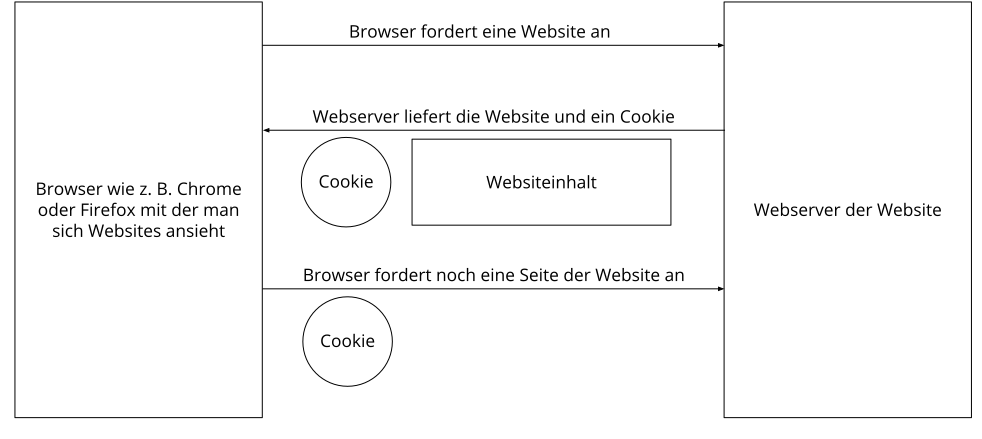
The following graphic shows a possible interaction between a web browser such as Chrome and the web server. The web browser requests a website and receives a cookie back from the server, which the browser reuses when another page is requested.
There are both first-party cookies and third-party cookies. First-party cookies are created directly by our site, while third-party cookies are created by partner websites (e.g., Google Analytics). Each cookie must be evaluated individually, as each cookie stores different data. The expiration time of a cookie also varies from a few minutes to a few years. Cookies are not software programs and do not contain viruses, Trojans, or other “malware.” Cookies cannot access information on your PC.
Cookie data may look like this, for example:
Name: _ga
Value: GA1.2.1326744211.152313093158-9
Purpose: Distinguishing website visitors
Expiration date: After 2 years
A browser should be able to support these minimum sizes:
At least 4096 bytes per cookie
At least 50 cookies per domain
At least 3000 cookies in total
What types of cookies are there?
The question of which cookies we use specifically depends on the services used and is clarified in the following sections of the privacy policy. At this point, we would like to briefly discuss the different types of HTTP cookies.
There are four types of cookies:
Essential cookies
These cookies are necessary to ensure the basic functionality of the website. For example, these cookies are needed when a user adds a product to their shopping cart, then continues browsing other pages and only proceeds to checkout later. These cookies ensure that the shopping cart is not deleted even if the user closes their browser window.
Functional cookies
These cookies collect information about user behavior and whether the user receives any error messages. These cookies are also used to measure the loading time and behavior of the website in different browsers.
Targeted cookies
These cookies ensure better user-friendliness. For example, they store entered locations, font sizes, or form data.
Advertising cookies
These cookies are also called targeting cookies. They are used to deliver personalized advertising to the user. This can be very practical, but also very annoying.
Usually, when you visit a website for the first time, you are asked which of these cookie types you want to allow. And, of course, this decision is also stored in a cookie.
If you would like to learn more about cookies and are not afraid of technical documentation, we recommend https://datatracker.ietf.org/doc/html/rfc6265, the Request for Comments from the Internet Engineering Task Force (IETF) entitled “HTTP State Management Mechanism.”
Purpose of processing via cookies
The purpose ultimately depends on the respective cookie. You can find more details below or from the manufacturer of the software that sets the cookie.
What data is processed?
Cookies are small helpers for many different tasks. Unfortunately, it is not possible to generalize what data is stored in cookies, but we will inform you about the processed or stored data in the following privacy policy.
Cookie storage period
The storage period depends on the cookie in question and is specified below. Some cookies are deleted after less than an hour, while others can remain stored on a computer for several years.
You also have control over the storage period. You can manually delete all cookies at any time via your browser (see also “Right to object” below). Furthermore, cookies that are based on consent will be deleted at the latest after you revoke your consent, whereby the legality of the storage remains unaffected until then.
Right to object – how can I delete cookies?
You decide how and whether you want to use cookies. Regardless of which service or website the cookies come from, you always have the option to delete, deactivate, or only partially allow cookies. For example, you can block third-party cookies but allow all other cookies.
If you want to find out which cookies have been stored in your browser, or if you want to change or delete cookie settings, you can find this in your browser settings:
Chrome: Delete, enable, and manage cookies in Chrome
Safari: Manage cookies and website data with Safari
Firefox: Delete cookies to remove data that websites have stored on your computer
Internet Explorer: Delete and manage cookies
Microsoft Edge: Delete and manage cookies
If you do not want cookies at all, you can set your browser to always inform you when a cookie is about to be set. This allows you to decide whether to accept or reject each individual cookie. The procedure varies depending on the browser. The best way to find the instructions is to search Google using the search term “delete cookies Chrome” or “disable cookies Chrome” if you are using the Chrome browser.
legal basis
The so-called “cookie guidelines” have been in place since 2009. These stipulate that the storage of cookies requires your consent (Article 6(1)(a) GDPR). However, there are still very different responses to these guidelines within EU countries. In Austria, however, this directive was implemented in Section 165(3) of the Telecommunications Act (2021). In Germany, the cookie guidelines have not been implemented as national law. Instead, this directive has been largely implemented in Section 15 (3) of the Telemedia Act (TMG), which was replaced by the Digital Services Act (DDG) in May 2024.
For cookies that are absolutely necessary, even if no consent has been given, there are legitimate interests (Article 6(1)(f) GDPR), which in most cases are of an economic nature. We want to provide visitors to the website with a pleasant user experience, and certain cookies are often absolutely necessary for this.
If cookies that are not absolutely necessary are used, this will only happen with your consent. The legal basis for this is Art. 6 (1) (a) GDPR.
The following sections provide more detailed information about the use of cookies, if the software used employs cookies.
Web Analytics Introduction
| Web Analytics Privacy Policy Summary
👥 Data subjects: Website visitors 🤝 Purpose: Evaluation of visitor information to optimize the website. 📓 Processed data: Access statistics containing data such as access locations, device data, access duration and time, navigation behavior, click behavior, and IP addresses. More details can be found in the respective web analytics tool used. 📅 Storage period: Depends on the web analytics tool used. ⚖️ Legal basis: Art. 6 (1) (a) GDPR (consent), Art. 6 (1) (f) GDPR (legitimate interests) |
What is web analytics?
We use software on our website to evaluate the behavior of website visitors, known as web analytics or web analysis for short. This involves collecting data that is stored, managed, and processed by the respective analytics tool provider (also known as a tracking tool). The data is used to create analyses of user behavior on our website and made available to us as the website operator. In addition, most tools offer various testing options. This allows us to test which offers or content are most popular with our visitors. To do this, we show you two different offers for a limited period of time. After the test (known as an A/B test), we know which product or content our website visitors find more interesting. For such testing procedures, as well as for other analytics procedures, user profiles can also be created and the data stored in cookies.
Why do we use web analytics?
With our website, we have a clear goal in mind: we want to provide the best web offering on the market for our industry. To achieve this goal, we want to offer the best and most interesting content while also ensuring that you feel completely at home on our website. With the help of web analytics tools, we can take a closer look at the behavior of our website visitors and then improve our website for you and us accordingly. For example, we can see the average age of our visitors, where they come from, when our website is most visited, and which content or products are particularly popular. All this information helps us to optimize the website and thus tailor it to your needs, interests, and wishes.
What data is processed?
The exact data stored depends, of course, on the analysis tools used. However, as a rule, the following information is stored: what content you view on our website, which buttons or links you click on, when you visit a page, which browser you use, which device (PC, tablet, smartphone, etc.) you use to visit the website, and which computer system you use. If you have agreed that location data may also be collected, this data may also be processed by the web analysis tool provider.
Your IP address is also stored. According to the General Data Protection Regulation (GDPR), IP addresses are personal data. However, your IP address is usually stored in pseudonymized form (i.e., in an unrecognizable and abbreviated form). For the purposes of testing, web analysis, and web optimization, no direct data such as your name, age, address, or email address is stored. All such data, if collected, is stored in pseudonymized form. This means that you cannot be identified as an individual.
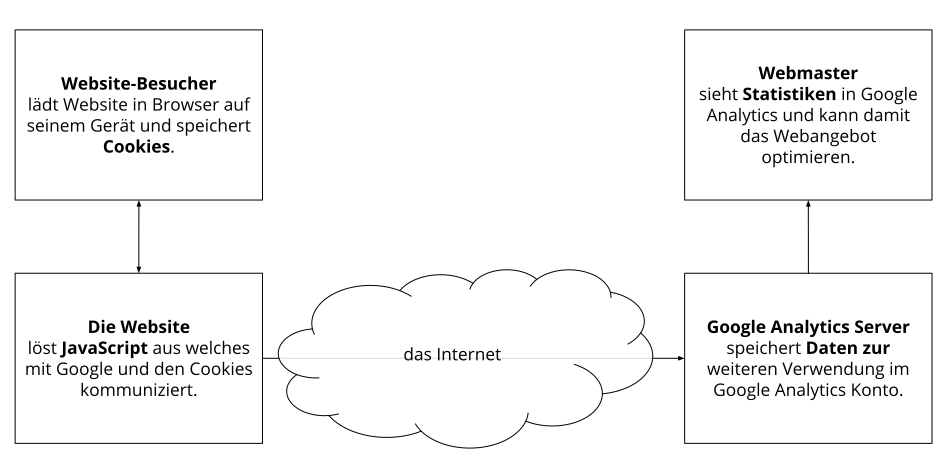
The following example shows schematically how Google Analytics works as an example of client-based web tracking with JavaScript code.
How long the respective data is stored always depends on the provider. Some cookies only store data for a few minutes or until you leave the website, while others can store data for several years.
Duration of data processing
We will inform you about the duration of data processing below, provided we have further information on this. In general, we only process personal data for as long as is absolutely necessary for the provision of our services and products. If required by law, as in the case of accounting, for example, this storage period may be exceeded.
right to object
You also have the right and the option to revoke your consent to the use of cookies or third-party providers at any time. You can do this either via our cookie management tool or via other opt-out functions. For example, you can also prevent data collection by cookies by managing, deactivating, or deleting cookies in your browser.
legal basis
The use of web analytics requires your consent, which we have obtained with our cookie pop-up. According to Art. 6 (1) (a) GDPR (consent), this consent constitutes the legal basis for the processing of personal data, as may occur when collected by web analytics tools.
In addition to consent, we have a legitimate interest in analyzing the behavior of website visitors in order to improve our offering both technically and economically. With the help of web analytics, we can detect website errors, identify attacks, and improve economic efficiency. The legal basis for this is Art. 6 (1) (f) GDPR (legitimate interests). However, we only use the tools if you have given your consent.
Since web analytics tools use cookies, we also recommend that you read our general privacy policy on cookies. To find out exactly which of your data is stored and processed, you should read the privacy policies of the respective tools.
Information on specific web analytics tools, if available, can be found in the following sections.
Google Analytics Privacy Policy
| Google Analytics Datenschutzerklärung Zusammenfassung
👥 Betroffene: Besucher der Website 🤝 Zweck: Auswertung der Besucherinformationen zur Optimierung des Webangebots. 📓 Verarbeitete Daten: Zugriffsstatistiken, die Daten wie Standorte der Zugriffe, Gerätedaten, Zugriffsdauer und Zeitpunkt, Navigationsverhalten und Klickverhalten enthalten. Mehr Details dazu finden Sie weiter unten in dieser Datenschutzerklärung. 📅 Speicherdauer: individuell einstellbar, standardmäßig speichert Google Analytics 4 Daten für 14 Monate ⚖️ Rechtsgrundlagen: Art. 6 Abs. 1 lit. a DSGVO (Einwilligung), Art. 6 Abs. 1 lit. f DSGVO (Berechtigte Interessen) |
What is Google Analytics?
We use the Google Analytics 4 (GA4) analysis tracking tool from the American company Google Inc. on our website. For the European region, Google Ireland Limited (Gordon House, Barrow Street Dublin 4, Ireland) is responsible for all Google services. Google Analytics collects data about your actions on our website. By combining various technologies such as cookies, device IDs, and login information, you as a user can be identified across different devices. This allows your actions to be analyzed across platforms.
For example, when you click on a link, this event is stored in a cookie and sent to Google Analytics. The reports we receive from Google Analytics help us to better tailor our website and services to your needs. Below, we will take a closer look at the tracking tool and, above all, inform you about what data is processed and how you can prevent this.
Google Analytics is a tracking tool used to analyze traffic on our website. These measurements and analyses are based on a pseudonymous user identification number. This number does not contain any personal data such as your name or address, but is used to assign events to a device. GA4 uses an event-based model that collects detailed information about user interactions such as page views, clicks, scrolling, and conversion events. In addition, various machine learning functions have been built into GA4 to better understand user behavior and certain trends. GA4 relies on modeling with the help of machine learning functions. This means that based on the data collected, missing data can also be extrapolated in order to optimize the analysis and also to be able to make predictions.
In order for Google Analytics to function, a tracking code is embedded in the code of our website. When you visit our website, this code records various events that you perform on our website. With GA4’s event-based data model, we as website operators can define and track specific events to obtain analyses of user interactions. This means that, in addition to general information such as clicks or page views, specific events that are important to our business can also be tracked. Such specific events can be, for example, submitting a contact form or purchasing a product.
As soon as you leave our website, this data is sent to the Google Analytics servers and stored there.
Google processes the data and we receive reports on your user behavior. These reports may include the following:
Audience reports: Audience reports help us get to know our users better and understand more precisely who is interested in our service.
Advertising reports: Advertising reports make it easier for us to analyze and improve our online advertising.
Acquisition reports: Acquisition reports provide us with helpful information on how we can get more people excited about our service.
Behavior reports: These reports tell us how you interact with our website. We can track your path through our site and see which links you click on.
Conversion reports: Conversion is the process by which you perform a desired action based on a marketing message. For example, when you go from being a mere website visitor to a buyer or newsletter subscriber. These reports help us learn more about how our marketing efforts are resonating with you. This is how we aim to increase our conversion rate.
Real-time reports: Here, we can always see immediately what is happening on our website. For example, we can see how many users are currently reading this text.
In addition to the analysis reports mentioned above, Google Analytics 4 also offers the following functions, among others:
Event-based data model: This model records very specific events that can take place on our website. For example, playing a video, purchasing a product, or subscribing to our newsletter.
Advanced analytics features: These features allow us to better understand your behavior on our website or certain general trends. For example, we can segment user groups, perform comparative analyses of target groups, or track your path on our website.
Predictive modeling: Based on collected data, machine learning can be used to extrapolate missing data that predicts future events and trends. This can help us develop better marketing strategies.
Cross-platform analysis: Data can be collected and analyzed from both websites and apps. This allows us to analyze user behavior across platforms, provided you have consented to data processing, of course.
Why do we use Google Analytics on our website?
Our goal with this website is clear: we want to offer you the best possible service. The statistics and data from Google Analytics help us achieve this goal.
The statistically evaluated data gives us a clear picture of the strengths and weaknesses of our website. On the one hand, we can optimize our site so that it is easier for interested people to find on Google. On the other hand, the data helps us to better understand you as a visitor. This means we know exactly what we need to improve on our website in order to offer you the best possible service. The data also helps us to tailor our advertising and marketing activities more effectively and cost-efficiently. After all, it only makes sense to show our products and services to people who are interested in them.
What data is stored by Google Analytics?
Google Analytics uses a tracking code to create a random, unique ID that is linked to your browser cookie. This allows Google Analytics to recognize you as a new user and assign you a user ID. The next time you visit our site, you will be recognized as a “returning” user. All collected data is stored together with this user ID. This is the only way to evaluate pseudonymous user profiles.
In order to analyze our website with Google Analytics, a property ID must be inserted into the tracking code. The data is then stored in the corresponding property. For each newly created property, the Google Analytics 4 property is the default. Depending on the property used, data is stored for different lengths of time.
Through identifiers such as cookies, app instance IDs, user IDs, or custom event parameters, your interactions are measured across platforms, provided you have consented to this. Interactions are all types of actions you perform on our website. If you also use other Google systems (such as a Google account), data generated by Google Analytics may be linked to third-party cookies. Google does not share Google Analytics data unless we, as the website operator, approve it. Exceptions may occur if required by law.
According to Google, IP addresses are not logged or stored in Google Analytics 4. However, Google uses IP address data to derive location data and deletes it immediately afterwards. All IP addresses collected from users in the EU are therefore deleted before the data is stored in a data center or on a server.
Since Google Analytics 4 focuses on event-based data, the tool uses significantly fewer cookies compared to previous versions (such as Google Universal Analytics). Nevertheless, there are some specific cookies that are used by GA4. These include, for example:
Name: _ga
Value: 2.1326744211.152313093158-5
Purpose: By default, analytics.js uses the _ga cookie to store the user ID. It is primarily used to distinguish between website visitors.
Expiration date: after 2 years
Name: _gid
Value: 2.1687193234.152313093158-1
Purpose: This cookie is also used to distinguish between website visitors.
Expiration date: after 24 hours
Name: _gat_gtag_UA_Value: 1
Purpose: Used to reduce the request rate. If Google Analytics is provided via Google Tag Manager, this cookie is named _dc_gtm_.
Expiration date: after 1 minute
Note: This list cannot claim to be exhaustive, as Google constantly changes its choice of cookies. GA4 also aims to improve data protection. The tool therefore offers a number of options for controlling data collection. For example, we can specify the storage period ourselves and also control data collection.
Here is an overview of the most important types of data collected by Google Analytics:
Heat maps: Google creates so-called heat maps. Heat maps show exactly which areas you click on. This gives us information about where you are “traveling” on our site.
Session duration: Google defines session duration as the time you spend on our site without leaving it. If you have been inactive for 20 minutes, the session ends automatically.
Bounce rate: A bounce occurs when you view only one page on our website and then leave our website.
Account creation: When you create an account or place an order on our website, Google Analytics collects this data.
Location: IP addresses are not logged or stored in Google Analytics. However, shortly before the IP address is deleted, derivations are used for location data.
Technical information: Technical information includes your browser type, your internet service provider, and your screen resolution.
Source of origin: Google Analytics and we are of course also interested in which website or advertisement brought you to our site.
Other data includes contact details, any reviews, media playback (e.g., if you play a video on our site), sharing content via social media, or adding to your favorites. This list is not exhaustive and is only intended to provide a general overview of data storage by Google Analytics.
How long and where is the data stored?
Google has servers all over the world. Here you can see exactly where Google’s data centers are located: https://datacenters.google/
Your data is distributed across various physical data carriers. This has the advantage that the data can be accessed more quickly and is better protected against manipulation. Every Google data center has appropriate emergency programs for your data. If, for example, Google’s hardware fails or natural disasters cripple servers, the risk of service interruption at Google remains low.
The retention period for data depends on the properties used. The storage period is always specified separately for each individual property. Google Analytics offers us four options for controlling the storage period:
2 months: this is the shortest storage period.
14 months: by default, data is stored for 14 months in GA4.
26 months: data can also be stored for 26 months.
Data is only deleted when we delete it manually
There is also the option of only deleting data if you do not visit our website again within the period we have selected. In this case, the retention period is reset each time you visit our website again within the specified period.
Once the specified period has expired, the data is deleted once a month. This retention period applies to your data linked to cookies, user recognition, and advertising IDs (e.g., cookies from the DoubleClick domain). Reporting results are based on aggregated data and are stored independently of user data. Aggregated data is a combination of individual data into a larger unit.
How can I delete my data or prevent data storage?
Under European Union data protection law, you have the right to obtain information about your data, to update it, to delete it, or to restrict its use. You can prevent Google Analytics 4 from using your data by using the browser add-on to disable Google Analytics JavaScript (analytics.js, gtag.js). You can download and install the browser add-on at https://tools.google.com/dlpage/gaoptout?hl=de. Please note that this add-on only deactivates data collection by Google Analytics.
If you want to deactivate, delete, or manage cookies in general, you will find the relevant links to the respective instructions for the most popular browsers in the “Cookies” section.
legal basis
The use of Google Analytics requires your consent, which we have obtained with our cookie pop-up. According to Art. 6 (1) (a) GDPR (consent), this consent constitutes the legal basis for the processing of personal data, as may occur when collected by web analytics tools.
In addition to consent, we have a legitimate interest in analyzing the behavior of website visitors in order to improve our offering both technically and economically. With the help of Google Analytics, we can detect website errors, identify attacks, and improve economic efficiency. The legal basis for this is Art. 6 (1) (f) GDPR (legitimate interests). However, we only use Google Analytics if you have given your consent.
Google also processes your data in the USA, among other places. Google is an active participant in the EU-US Data Privacy Framework, which regulates the correct and secure transfer of personal data from EU citizens to the USA. For more information, please visit https://commission.europa.eu/document/fa09cbad-dd7d-4684-ae60-be03fcb0fddf_en.
In addition, Google uses so-called standard contractual clauses (= Art. 46 (2) and (3) GDPR). Standard contractual clauses (SCC) are model templates provided by the EU Commission and are intended to ensure that your data complies with European data protection standards even if it is transferred to third countries (such as the US) and stored there. Through the EU-US Data Privacy Framework and the standard contractual clauses, Google undertakes to comply with European data protection standards when processing your relevant data, even if the data is stored, processed, and managed in the US. These clauses are based on an implementing decision by the EU Commission. You can find the decision and the corresponding standard contractual clauses here, among other places: https://eur-lex.europa.eu/eli/dec_impl/2021/914/oj?locale=de
The Google Ads Data Processing Terms, which refer to the standard contractual clauses, can be found at https://business.safety.google/intl/de/adsprocessorterms/.
We hope we have been able to provide you with the most important information about data processing by Google Analytics. If you would like to learn more about the tracking service, we recommend these two links: https://marketingplatform.google.com/about/analytics/terms/de/ and https://support.google.com/analytics/answer/6004245?hl=de.
If you would like to learn more about data processing, please refer to Google’s privacy policy at https://policies.google.com/privacy?hl=de.
Google Analytics in consent mode
Depending on your consent, your personal data will be processed by Google Analytics in what is known as consent mode. You can choose whether or not to accept Google Analytics cookies. This also allows you to choose which data Google Analytics is allowed to process about you. The data collected is mainly used to measure user behavior on the website, display targeted advertising, and provide us with web analytics reports. As a rule, you consent to data processing by Google via a cookie consent tool. If you do not consent to data processing, only aggregated data will be collected and processed. This means that data cannot be assigned to individual users and therefore no user profile of you will be created. You can also consent to statistical measurement only. In this case, no personal data will be processed and therefore not used for advertising or advertising success measurement.
Cookie Consent Management Platform Introduction
| Cookie Consent Management Platform Summary
👥 Data subjects: Website visitors 🤝 Purpose: Obtaining and managing consent for certain cookies and thus the use of certain tools 📓 Processed data: Data for managing cookie settings, such as IP address, time of consent, type of consent, individual consents. More details can be found in the tool used. 📅 Storage period: Depends on the tool used; you should expect periods of several years. ⚖️ Legal basis: Art. 6 (1) (a) GDPR (consent), Art. 6 (1) (f) GDPR (legitimate interests) |
What is a cookie consent management platform?
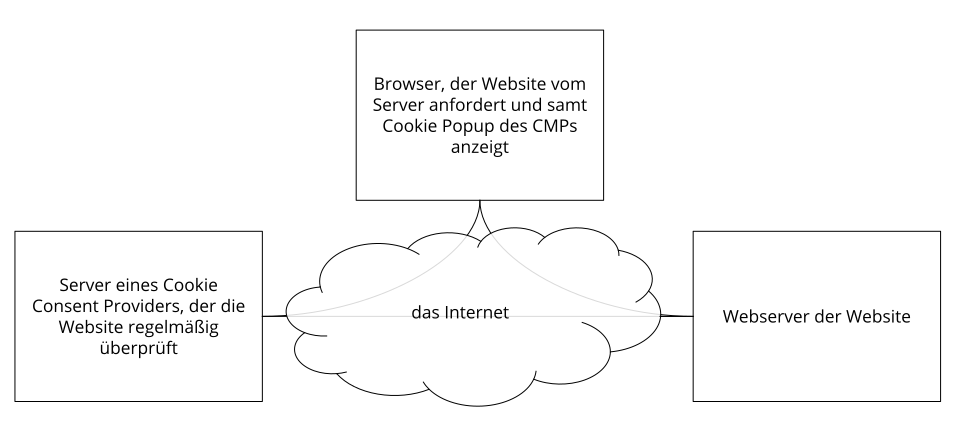
We use consent management platform (CMP) software on our website, which makes it easier for us and you to handle scripts and cookies correctly and securely. The software automatically creates a cookie pop-up, scans and checks all scripts and cookies, provides you with the cookie consent required by data protection law, and helps us and you keep track of all cookies. Most cookie consent management tools identify and categorize all existing cookies. As a website visitor, you then decide for yourself whether and which scripts and cookies you allow or do not allow. The following graphic illustrates the relationship between the browser, web server, and CMP.
Why do we use a cookie management tool?
Our goal is to offer you the best possible transparency in the area of data protection. We are also legally obliged to do so. We want to inform you as clearly as possible about all tools and cookies that can store and process your data. It is also your right to decide for yourself which cookies you accept and which you do not. In order to grant you this right, we first need to know exactly which cookies have ended up on our website. Thanks to a cookie management tool that regularly scans the website for all existing cookies, we know about all cookies and can provide you with information about them in accordance with the GDPR. You can then accept or reject cookies via the consent system.
What data is processed?
Our cookie management tool allows you to manage each individual cookie yourself and gives you complete control over the storage and processing of your data. Your consent is stored so that we do not have to ask you for it every time you visit our website and so that we can prove your consent if required by law. This is stored either in an opt-in cookie or on a server. The storage period for your cookie consent varies depending on the provider of the cookie management tool. In most cases, this data (such as pseudonymous user ID, time of consent, details of cookie categories or tools, browser, device information) is stored for up to two years.
Duration of data processing
We will inform you about the duration of data processing below, provided we have further information on this. In general, we only process personal data for as long as is absolutely necessary to provide our services and products. Data stored in cookies is stored for varying lengths of time. Some cookies are deleted as soon as you leave the website, while others may remain stored in your browser for several years. The exact duration of data processing depends on the tool used, but in most cases you should expect a storage period of several years. The respective privacy policies of the individual providers usually provide detailed information about the duration of data processing.
right of objection
You also have the right and the option to revoke your consent to the use of cookies at any time. You can do this either via our cookie management tool or via other opt-out functions. For example, you can also prevent data collection by cookies by managing, deactivating, or deleting cookies in your browser.
Information on specific cookie management tools, if available, can be found in the following sections.
legal basis
If you agree to cookies, your personal data will be processed and stored via these cookies. If we are permitted to use cookies with your consent (Article 6(1)(a) GDPR), this consent also constitutes the legal basis for the use of cookies and the processing of your data. Cookie consent management platform software is used to manage consent to cookies and to enable you to give your consent. The use of this software enables us to operate the website in an efficient and legally compliant manner, which constitutes a legitimate interest (Article 6(1)(f) GDPR).
BorlabsCookie Privacy Policy
We use BorlabsCookie on our website, which is, among other things, a tool for storing your cookie consent. The service provider is the German company Borlabs – Benjamin A. Bornschein, Rübenkamp 32, 22305 Hamburg, Germany.
You can find out more about the data processed through the use of BorlabsCookie in the privacy policy at
https://de.borlabs.io/datenschutz/.
Security & Anti-Spam
| Security & Anti-Spam Privacy Policy Summary
👥 Data subjects: Website visitors 🤝 Purpose: Cybersecurity 📓 Processed data: Data such as your IP address, name, or technical data such as browser version More details can be found below and in the individual privacy policy texts. 📅 Storage period: In most cases, the data is stored until it is no longer needed to fulfill the service. ⚖️ Legal basis: Art. 6 (1) (a) GDPR (consent), Art. 6 (1) (f) GDPR (legitimate interests) |
What is security and anti-spam software?
from various spam or phishing emails and other possible cyberattacks. Spam refers to unsolicited advertising emails sent in bulk. Such emails are also known as junk mail and can incur costs. Phishing emails, on the other hand, are messages that aim to build trust through fake messages or websites in order to obtain personal data. Anti-spam software usually protects against unwanted spam messages or malicious emails that could introduce viruses into our system. We also use general firewall and security systems that protect our computers from unwanted network attacks.
Why do we use security and anti-spam software?
We place particular emphasis on security on our website. After all, it’s not just about our security, but above all about yours. Unfortunately, cyber threats have become part of everyday life in the world of IT and the internet. Hackers often use cyber attacks to try to steal personal data from IT systems. That’s why a good defense system is absolutely essential. A security system monitors all incoming and outgoing connections to our network and computers. In order to achieve even greater security against cyber attacks, we use additional external security services in addition to the standardized security systems on our computers. This better prevents unauthorized data traffic and protects us from cybercrime.
What data is processed by security and anti-spam software?
The exact data collected and stored depends, of course, on the service in question. However, we always endeavor to use only programs that collect data very sparingly or only store data that is necessary for the performance of the service offered. In principle, the service may store data such as name, address, IP address, email address, and technical data such as browser type or browser version. Performance and log data may also be collected in order to detect potential threats in a timely manner. This data is processed within the scope of the services and in compliance with applicable laws. This also includes the GDPR for US providers (via the standard contractual clauses). In some cases, these security services also work with third-party providers who may store and/or process data under instruction and in accordance with data protection guidelines and other security measures. Data storage is usually done via cookies.
Duration of data processing
We will inform you about the duration of data processing below, provided we have further information on this. For example, security programs store data until you or we revoke the data storage. In general, personal data is only stored for as long as is absolutely necessary for the provision of services. In many cases, unfortunately, we do not have precise information from the providers about the length of storage.
right of objection
You also have the right and option to revoke your consent to the use of cookies or third-party security software at any time. You can do this either via our cookie management tool or via other opt-out functions. For example, you can also prevent data collection by cookies by managing, deactivating, or deleting cookies in your browser.
Since cookies may also be used by such security services, we recommend that you read our general privacy policy on cookies. To find out exactly which of your data is stored and processed, you should read the privacy policies of the respective tools.
legal basis
We use security services primarily on the basis of our legitimate interests (Art. 6 (1) (f) GDPR) in a good security system against various cyber attacks.
Certain processing operations, in particular the use of cookies and security functions, require your consent. If you have consented to your data being processed and stored by integrated security services, this consent serves as the legal basis for data processing (Art. 6 (1) (a) GDPR). Most of the services we use set cookies in your browser to store data. We therefore recommend that you read our privacy policy on cookies carefully and review the privacy policy or cookie policy of the respective service provider.
Information on specific tools, if available, can be found in the following sections.
Akismet Privacy Policy
We use Akismet, an anti-spam solution for WordPress, for our website. The service provider is the American company Automattic Inc., 60 29th Street #343, San Francisco, CA 94110, USA.
Automattic processes your data in the USA, among other places. Akismet and Automattic are active participants in the EU-US Data Privacy Framework, which regulates the correct and secure transfer of personal data from EU citizens to the USA. You can find more information on this at https://commission.europa.eu/document/fa09cbad-dd7d-4684-ae60-be03fcb0fddf_en.
Automattic also uses standard contractual clauses (SCCs) (Art. 46(2) and (3) GDPR). Standard contractual clauses (SCC) are model templates provided by the EU Commission and are intended to ensure that your data complies with European data protection standards even if it is transferred to third countries (such as the US) and stored there. Through the EU-US Data Privacy Framework and the standard contractual clauses, Automattic undertakes to comply with European data protection standards when processing your relevant data, even if the data is stored, processed, and managed in the US. These clauses are based on an implementing decision by the EU Commission. You can find the decision and the corresponding standard contractual clauses here, among other places: https://eur-lex.europa.eu/eli/dec_impl/2021/914/oj?locale=de.
The Data Processing Agreements, which refer to the Standard Contractual Clauses, can be found at https://wordpress.com/support/data-processing-agreements/.
For more information about the data processed by Akismet and WordPress, please refer to the privacy policy at https://automattic.com/de/privacy/.
Audio & Video Introduction
| Audio & Video Privacy Policy Summary
👥 Data subjects: Website visitors 🤝 Purpose: Optimization of our services 📓 Processed data: Data such as contact details, user behavior data, information about your device, and your IP address may be stored. More details can be found below in the relevant privacy policy texts. 📅 Storage period: Data is generally stored for as long as it is necessary for the purpose of the service. ⚖️ Legal basis: Art. 6 (1) (a) GDPR (consent), Art. 6 (1) (f) GDPR (legitimate interests) |
What are audio and video elements?
We have integrated audio and video elements into our website so that you can watch videos or listen to music/podcasts directly via our website. The content is provided by service providers. All content is therefore also obtained from the providers’ respective servers.
These are integrated functional elements from platforms such as YouTube, Vimeo, or Spotify. The use of these portals is usually free of charge, but paid content may also be published. With the help of these integrated elements, you can listen to or view the respective content via our website.
When you use audio or video elements on our website, your personal data may also be transmitted to the service providers, processed, and stored.
Why do we use audio and video elements on our website?
Of course, we want to provide you with the best possible service on our website. And we are aware that content is no longer conveyed solely through text and static images. Instead of simply providing you with a link to a video, we offer audio and video formats directly on our website that are entertaining or informative, and ideally both. This expands our service and makes it easier for you to access interesting content. In addition to our texts and images, we also offer video and/or audio content.
What data is stored by audio and video elements?
When you visit a page on our website that has an embedded video, for example, your server connects to the service provider’s server. In doing so, data about you is also transferred to the third-party provider and stored there. Some data is collected and stored regardless of whether you have an account with the third-party provider or not. This usually includes your IP address, browser type, operating system, and other general information about your device. Furthermore, most providers also collect information about your web activity. This includes, for example, session duration, bounce rate, which buttons you clicked on, or which website you used to access the service. All this information is usually stored via cookies or pixel tags (also known as web beacons). Pseudonymized data is usually stored in cookies in your browser. You can always find out exactly which data is stored and processed in the privacy policy of the respective provider.
Duration of data processing
You can find out exactly how long the data is stored on the servers of third-party providers either further down in the privacy policy for the respective tool or in the provider’s privacy policy. As a matter of principle, personal data is only ever processed for as long as is absolutely necessary for the provision of our services or products. This also applies to third-party providers as a rule. In most cases, you can assume that certain data will be stored on the servers of third-party providers for several years. Data can be stored for varying lengths of time, especially in cookies. Some cookies are deleted as soon as you leave the website, while others may remain stored in your browser for several years.
right of objection
You also have the right and option to revoke your consent to the use of cookies or third-party providers at any time. You can do this either via our cookie management tool or via other opt-out functions. For example, you can also prevent data collection by cookies by managing, deactivating, or deleting cookies in your browser. The legality of the processing until revocation remains unaffected.
Since cookies are usually also used by the integrated audio and video functions on our site, you should also read our general privacy policy on cookies. You can find out more about the handling and storage of your data in the privacy policies of the respective third-party providers.
legal basis
If you have consented to your data being processed and stored by integrated audio and video elements, this consent serves as the legal basis for data processing (Art. 6 (1) (a) GDPR). In principle, your data is also stored and processed on the basis of our legitimate interest (Art. 6 (1) (f) GDPR) in fast and effective communication with you or other customers and business partners. However, we only use the integrated audio and video elements if you have given your consent.
Web Design Introduction
| Web design privacy policy summary
👥 Data subjects: Website visitors 🤝 Purpose: Improving the user experience 📓 Processed data: The data processed depends heavily on the services used. In most cases, this includes the IP address, technical data, language settings, browser version, screen resolution, and browser name. You can find more details on this in the respective web design tools used. 📅 Storage period: Depends on the tools used ⚖️ Legal basis: Art. 6 (1) (a) GDPR (consent), Art. 6 (1) (f) GDPR (legitimate interests) |
What is web design?
We use various tools on our website that serve our web design purposes. Contrary to popular belief, web design is not just about making our website look pretty, but also about functionality and performance. But of course, the right look for a website is also one of the main goals of professional web design. Web design is a subfield of media design and deals with the visual as well as the structural and functional design of a website. The aim of web design is to improve your experience on our website. In web design jargon, this is referred to as user experience (UX) and usability. User experience refers to all the impressions and experiences that a website visitor has on a website. One sub-item of user experience is usability. This refers to the user-friendliness of a website. The main focus here is on ensuring that content, subpages, or products are clearly structured and that you can find what you are looking for quickly and easily. In order to offer you the best possible experience on our website, we also use third-party web design tools. In this privacy policy, the category “web design” therefore includes all services that improve the design of our website. These can be, for example, fonts, various plugins, or other integrated web design functions.
Why do we use web design tools?
How you absorb information on a website depends heavily on the structure, functionality, and visual perception of the website. That is why good, professional web design has become increasingly important to us. We are constantly working to improve our website and see this as an extended service for you as a website visitor. Furthermore, an attractive and functional website also has economic advantages for us. After all, you will only visit us and take advantage of our offers if you feel completely at ease.
What data is stored by web design tools?
When you visit our website, web design elements may be integrated into our pages that can also process data. The exact nature of this data depends heavily on the tools used. Below, you can see exactly which tools we use for our website. For more detailed information about data processing, we recommend that you also read the respective privacy policy of the tools used. In most cases, you will find out what data is processed, whether cookies are used, and how long the data is stored. Fonts such as Google Fonts, for example, also automatically transmit information such as language settings, IP address, browser version, browser screen resolution, and browser name to Google servers.
Duration of data processing
How long data is processed is very individual and depends on the web design elements used. If cookies are used, for example, the storage period can be as short as one minute or as long as a few years. Please inform yourself about this. We recommend reading our general section on cookies and the privacy policies of the tools used. There you will usually find out exactly which cookies are used and what information is stored in them. Google font files, for example, are stored for one year. This is to improve the loading time of a website. As a rule, data is only stored for as long as is necessary to provide the service. Data may also be stored for longer periods if required by law.
right of objection
You also have the right and option to revoke your consent to the use of cookies or third-party providers at any time. You can do this either via our cookie management tool or via other opt-out functions. You can also prevent data collection by cookies by managing, deactivating, or deleting cookies in your browser. However, some web design elements (usually fonts) contain data that cannot be deleted so easily. This is the case when data is automatically collected when a page is accessed and transmitted to a third-party provider (such as Google). In this case, please contact the support team of the relevant provider. In the case of Google, you can reach their support team at https://support.google.com/?hl=de.
legal basis
If you have consented to the use of web design tools, this consent forms the legal basis for the corresponding data processing. According to Art. 6 (1) (a) GDPR (consent), this consent forms the legal basis for the processing of personal data, as may occur when collected by web design tools. We also have a legitimate interest in improving the web design of our website. After all, this is the only way we can provide you with an attractive and professional website. The corresponding legal basis for this is Art. 6 (1) (f) GDPR (legitimate interests). However, we only use web design tools if you have given your consent. We would like to emphasize this again here.
Information on specific web design tools can be found in the following sections, if available.
Adobe Fonts Privacy Policy
We use Adobe Fonts, a web font hosting service, on our website. The service provider is the American company Adobe Inc. For the European region, the Irish company Adobe Systems Software Ireland Companies, 4-6 Riverwalk, Citywest Business Campus, Dublin 24, Ireland, is responsible.
Adobe also processes your data in the USA, among other places. Adobe is an active participant in the EU-US Data Privacy Framework, which regulates the correct and secure transfer of personal data from EU citizens to the USA. You can find more information on this at https://commission.europa.eu/document/fa09cbad-dd7d-4684-ae60-be03fcb0fddf_en.
Zudem verwendet Adobe sogenannte Standardvertragsklauseln (= Art. 46. Abs. 2 und 3 DSGVO). Standardvertragsklauseln (Standard Contractual Clauses – SCC) sind von The templates provided by the EU Commission are intended to ensure that your data complies with European data protection standards even when it is transferred to and stored in third countries (such as the US). Through the EU-US Data Privacy Framework and the standard contractual clauses, Adobe commits to complying with European data protection standards when processing your relevant data, even if the data is stored, processed, and managed in the US. These clauses are based on an implementing decision by the EU Commission. You can find the decision and the corresponding standard contractual clauses here: https://eur-lex.europa.eu/eli/dec_impl/2021/914/oj?locale=de
For more information about Adobe’s standard contractual clauses, please visit https://www.adobe.com/at/privacy/eudatatransfers.html.
For more information about the data processed when using Adobe Fonts, please refer to the Privacy Policy at https://www.adobe.com/at/privacy.html.
Font Awesome Privacy Policy
| ont Awesome Privacy Policy Summary
👥 Data subjects: Website visitors 🤝 Purpose: Optimization of our services 📓 Processed data: IP address and which icon files are loaded More details can be found further down in this privacy policy. 📅 Storage period: Files in identifiable form are stored for a few weeks. ⚖️ Legal basis: Art. 6 (1) (a) GDPR (consent), Art. 6 (1) (f) GDPR (legitimate interests) |
What is Font Awesome?
We use Font Awesome from the American company Fonticons (307 S. Main St., Suite 202, Bentonville, AR 72712, USA) on our website. When you visit one of our web pages, the Font Awesome web font (specifically icons) is loaded via the Font Awesome Content Delivery Network (CDN). This ensures that the texts, fonts, and icons are displayed correctly on every device. In this privacy policy, we go into more detail about data storage and data processing by this service.
Icons are playing an increasingly important role for websites. Font Awesome is a web font that was developed specifically for web designers and web developers. With Font Awesome, icons can be scaled and colored as desired using the CSS stylesheet language. They thus replace old image icons. Font Awesome CDN is the easiest way to load the icons or fonts onto your website. To do this, we only had to embed a small line of code into our website.
Why do we use Font Awesome on our website?
Font Awesome allows us to present content on our website more effectively. This makes it easier for you to navigate our website and understand the content. The icons can even replace entire words in some cases, saving space. This is particularly useful when we optimize content specifically for smartphones. These icons are inserted as HTML code instead of images. This allows us to edit the icons with CSS exactly as we want. At the same time, Font Awesome also improves our loading speed because it only uses HTML elements and not icon images. All these advantages help us to make the website even clearer, fresher, and faster for you.
What data does Font Awesome store?
The Font Awesome Content Delivery Network (CDN) is used to load icons and symbols. CDNs are networks of servers distributed worldwide that enable files to be loaded quickly from nearby locations. This means that as soon as you visit one of our pages, the corresponding icons from Font Awesome are provided.
In order for the web fonts to be loaded, your browser must connect to the servers of Fonticons, Inc. Your IP address is recognized during this process. Font Awesome also collects data about which icon files are downloaded and when. Technical data such as your browser version, screen resolution, or the time the page was accessed is also transmitted.
This data is collected and stored for the following reasons:
to optimize content delivery networks
to detect and fix technical errors
to protect CDNs from misuse and attacks
to be able to charge fees to Font Awesome Pro customers
to find out the popularity of icons
to know which computer and software you are using
If your browser does not support web fonts, a standard font from your PC will be used automatically. To the best of our knowledge, no cookies are set. We are in contact with Font Awesome’s data protection department and will let you know as soon as we find out more.
How long and where is the data stored?
Font Awesome also stores data about the use of the content delivery network on servers in the United States of America. However, the CDN servers are located worldwide and store user data wherever you are located. In identifiable form, the data is usually only stored for a few weeks. Aggregated statistics on the use of the CDNs may also be stored for longer periods. Personal data is not included here.
How can I delete my data or prevent data storage?
To the best of our knowledge, Font Awesome does not store any personal data via content delivery networks. If you do not want data about the icons used to be stored, you will unfortunately not be able to visit our website. If your browser does not allow web fonts, no data will be transferred or stored. In this case, your computer’s default font will simply be used.
legal basis
If you have consented to the use of Font Awesome, the legal basis for the corresponding data processing is this consent. According to Art. 6 (1) (a) GDPR (consent), this consent constitutes the legal basis for the processing of personal data, as may occur when collected by Font Awesome.
We also have a legitimate interest in using Font Awesome to optimize our online service. The corresponding legal basis for this is Art. 6 (1) (f) GDPR (legitimate interests). However, we only use Font Awesome if you have given your consent.
We would like to point out that, in the opinion of the European Court of Justice, there is currently no adequate level of protection for data transfers to the USA. Data processing is mainly carried out by Font Awesome. This may mean that data is not processed and stored anonymously. Furthermore, US government authorities may have access to individual data. It may also happen that this data is linked to data from other Font Awesome services for which you have a user account.
If you would like to learn more about Font Awesome and how it handles data, we recommend that you read the privacy policy at https://fontawesome.com/privacy and the help page at https://fontawesome.com/support.
Google Fonts Local Privacy Policy
We use Google Fonts from Google Inc. on our website. Google Ireland Limited (Gordon House, Barrow Street, Dublin 4, Ireland) is responsible for the European region. We have integrated Google fonts locally, i.e. on our web server – not on Google’s servers. This means that there is no connection to Google servers and therefore no data transfer or storage.
What are Google Fonts?
Google Fonts used to be called Google Web Fonts. It is an interactive directory with over 800 fonts that Google provides free of charge. With Google Fonts, you could use fonts without uploading them to your own server. However, in order to prevent any transfer of information to Google servers, we have downloaded the fonts to our server. This way, we comply with data protection regulations and do not send any data to Google Fonts.
All texts are protected by copyright.
Source: Privacy policy created with the privacy policy generator for Germany by AdSimple..